

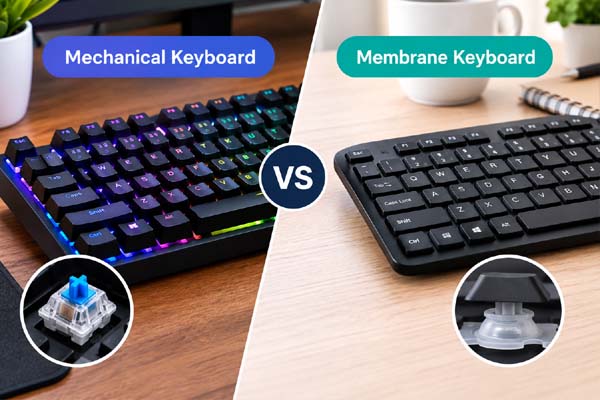
If you want better typing feedback, durability, and a more responsive feel, a mechanical keyboard is usually the stronger choice. A membrane keyboard, however, can be more affordable, quieter, and perfectly suitable for everyday tasks. The right option depends on how you use your computer, your budget, and whether typing feel or convenience matters most. Comparing the two types can help you choose a keyboard that fits your work, gaming, or general computing needs.
| Feature | Mechanical Keyboard | Membrane Keyboard |
| Key feel | Tactile and responsive | Softer and less defined |
| Durability | Generally higher | Generally lower |
| Noise | Can be louder | Usually quieter |
| Price | Often more expensive | Usually affordable |
| Gaming | Excellent | Suitable for casual gaming |
| Typing | Excellent feedback | Comfortable for basic use |
How Mechanical Keyboards Work
Mechanical keyboards use individual switches beneath each key. These switches register a keypress through a physical mechanism, giving users a more distinct and consistent response.
Different mechanical switches can provide different experiences. Some are tactile, some are linear, and others produce an audible click. This variety makes mechanical keyboards popular with gamers, programmers, writers, and people who spend many hours typing.
Another advantage is customization. Many mechanical keyboards allow users to replace keycaps and, on some models, switches. This makes it easier to adjust the keyboard’s appearance and typing experience.
Mechanical keyboards can also have a longer lifespan because their individual switches are designed to handle a large number of keypresses.
How Membrane Keyboards Work
Membrane keyboards use a pressure-sensitive membrane layer instead of separate mechanical switches. When you press a key, it pushes through the membrane and completes an electrical circuit.
This design is simpler and generally costs less to manufacture. As a result, membrane keyboards are common with office computers, budget desktops, laptops, and inexpensive keyboard-and-mouse sets.
The keys usually have a softer, quieter feel. Some people prefer this because it produces less noise in shared workspaces. The trade-off is that the key response may feel less precise compared with a mechanical model.
For browsing, writing emails, studying, and basic office work, a good membrane keyboard can still provide everything most users need.
Key Differences for Gaming and Typing
For gaming, mechanical keyboards are often preferred because their switches provide clear feedback and consistent actuation. This can make rapid key presses feel more responsive, particularly in games that require frequent movement or repeated inputs.
For typing, the choice is more personal. Mechanical switches can make each press feel more deliberate, which many writers and programmers appreciate. However, some users may find certain mechanical keyboards too loud or stiff.
Membrane keyboards offer a softer and quieter experience. They can be a practical choice for shared offices, libraries, or home environments where keyboard noise is a concern.
Neither type automatically makes someone a better gamer or faster typist. Comfort, layout, key spacing, and personal preference can have a significant impact.
Which Keyboard Should You Choose?
Choose a mechanical keyboard if you:
- Type or game for several hours each day
- Prefer noticeable key feedback
- Want a durable keyboard
- Enjoy customization
- Do not mind spending more
A membrane keyboard may be better if you:
- Want to keep costs low
- Prefer quiet keys
- Mainly browse, study, or perform office tasks
- Want a simple plug-and-play keyboard
- Do not need extensive customization
Consider the environment as well. A loud mechanical keyboard may not be ideal when working beside other people, while a membrane keyboard may feel less satisfying if you regularly perform intensive typing or gaming.
Conclusion and FAQs
Mechanical and membrane keyboards both have practical advantages. Mechanical models generally offer stronger feedback, greater customization, and excellent durability, while membrane keyboards provide affordability, quieter operation, and simple everyday performance. Your usage habits and preferred typing feel should guide the final decision.
Looking for wireless earbuds? Check this Wireless Earbuds Buying Guide before you buy.
FAQs
Are mechanical keyboards better than membrane keyboards?
Neither is universally better. Mechanical keyboards offer more feedback and customization, while membrane models are often cheaper and quieter.
Are mechanical keyboards good for gaming?
Yes. Their consistent switches and responsive feel make them popular among gamers, although gaming performance also depends on the player and other hardware.
Are membrane keyboards good for typing?
Yes. A quality membrane keyboard can be comfortable for everyday writing, office work, studying, and browsing.
Which type lasts longer?
Mechanical keyboards generally offer greater durability because their individual switches are designed for extensive use.
