

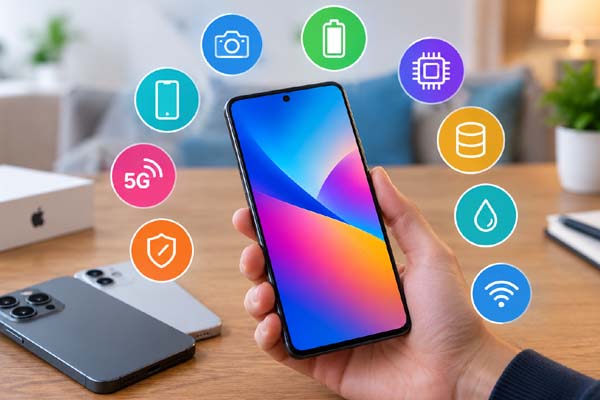
A good New Smartphone should offer more than a high price or attractive design. Before buying, check the display quality, processor, battery life, camera system, software support, storage, connectivity, durability, and charging speed. The right combination depends on how you use your phone. For everyday users, a reliable battery and smooth performance may matter most, while gamers and content creators may prioritize the processor, display, camera, and storage.
| Feature | What to Look For | Why It Matters |
| Display | OLED/AMOLED, 90Hz–120Hz | Smooth and clear viewing |
| Processor | Modern mid-range or flagship chip | Faster performance |
| Battery | 4,500mAh+ | Longer daily use |
| Camera | Good main sensor + stabilization | Better photos and videos |
| Storage | 128GB or more | More room for apps and media |
| Software | Regular updates | Security and longevity |
| Charging | Fast charging support | Less time near the charger |
| Durability | Strong glass, IP rating | Better protection |
1. Display Quality and Refresh Rate
The display is one of the features you interact with most, so it deserves careful attention. Look for an OLED or AMOLED panel if your budget allows it. These displays generally provide deeper blacks, strong contrast, and vibrant colors.
A higher refresh rate, such as 90Hz or 120Hz, can also make scrolling, animations, and supported games feel noticeably smoother. Brightness is another important factor, especially if you frequently use your phone outdoors.
Resolution matters too, but it should not be the only consideration. A well-calibrated Full HD+ display can provide an excellent viewing experience without unnecessarily increasing battery consumption.
2. Processor and Everyday Performance
The processor determines how smoothly a phone handles apps, multitasking, gaming, photography, and other demanding tasks. Instead of choosing a phone based only on the processor’s name, consider its generation and real-world performance.
For normal use, a modern mid-range processor can be more than enough. Heavy gamers and users who edit videos or use demanding applications should consider a more powerful chipset.
RAM also plays a role. Around 8GB is a comfortable starting point for many modern users, while heavier multitasking may benefit from more. However, more RAM does not automatically mean better performance if the processor and software are poorly optimized.
3. Battery Life and Charging Speed
Battery capacity is one of the most practical features to check when buying a smartphone. A battery around 4,500mAh to 5,000mAh is common in modern phones, although actual battery life depends on the display, processor, software, network use, and your habits.
Fast charging can be equally useful. It allows you to add a significant amount of battery power during a short break. Check both the maximum charging speed and whether the required charger is included with the phone.
Battery health features are also worth considering because intelligent charging controls can help reduce unnecessary battery wear over time.
4. Camera System and Storage
A phone with multiple cameras is not automatically better. Pay attention to the quality of the main camera, image processing, stabilization, low-light performance, and video recording capabilities.
Optical image stabilization (OIS) can help reduce blur caused by hand movement and is particularly useful for photos taken at night or while recording video. If you regularly create social media content, also check the front camera and video features.
Storage is another important consideration. 128GB can be suitable for many users, while 256GB or more is useful if you keep lots of videos, photos, games, or offline files. Since many phones no longer include a microSD slot, choosing enough built-in storage from the beginning can prevent problems later.
5. Software, Connectivity, and Durability
Software support can have a major effect on how long a phone remains useful. Before buying, check how many Android or iOS updates and security updates the manufacturer promises. A phone that receives regular updates can remain safer and more useful for several years.
Modern connectivity is also important. Depending on your needs, look for 5G, Wi-Fi 6 or newer, Bluetooth support, NFC, and a reliable USB-C port.
Finally, consider durability. An IP rating can provide protection against water and dust, while stronger display glass can reduce the risk of damage from everyday accidents. A quality case and screen protector can add another layer of protection.
Conclusion
Choosing a New Smartphone is easier when you focus on the features that affect everyday use. Prioritize a quality display, capable processor, dependable battery, useful camera system, sufficient storage, long software support, modern connectivity, and good durability. Instead of chasing specifications alone, choose a balanced phone that matches your actual needs and budget.
Need better connectivity? Check out our guide on how to make your Wi-Fi faster and fix common problems.
FAQs
1. How much storage should a new smartphone have?
For most users, 128GB is a practical starting point. Choose 256GB or more if you store many videos, photos, games, or large files.
2. Is a 120Hz display worth it?
Yes, if you value smoother scrolling, animations, and gaming. However, a good 60Hz or 90Hz display can still provide an enjoyable experience.
3. What battery capacity is good for a smartphone?
A 4,500mAh to 5,000mAh battery is a common range, but battery life also depends heavily on the processor, display, software, and usage.
4. Should I choose more RAM or a better processor?
A capable, modern processor is generally more important than simply having a larger amount of RAM. Look for a balanced combination of both.
