

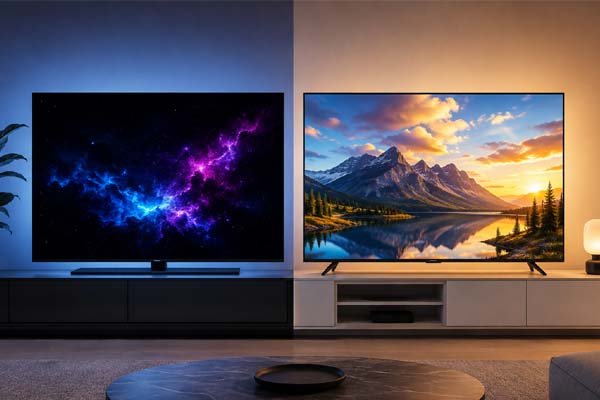
OLED generally offers the better picture quality because each pixel can turn itself on or completely off, producing deeper blacks, stronger contrast, and excellent viewing angles. LED TVs, however, are often more affordable, can get very bright, and may be a better choice for bright rooms or long periods of static content. In the OLED vs LED comparison, the right choice depends on your budget, room conditions, viewing habits, and whether you prioritize picture quality or practicality.
What Is the Difference Between OLED and LED?
The biggest difference is how the display produces light.
OLED (Organic Light-Emitting Diode) displays use self-emitting pixels. Each individual pixel creates its own light and can switch off completely when displaying black. This allows OLED screens to produce very deep blacks and excellent contrast.
LED TVs are technically LCD displays that use an LED backlight behind the LCD panel. The pixels themselves do not produce light. Because the backlight is always involved, black areas can sometimes appear slightly gray, especially on basic LED models.
Here is a quick comparison:
| Feature | OLED | LED |
| Black levels | Excellent | Good to very good |
| Contrast | Excellent | Good to excellent |
| Brightness | Very good | Often excellent |
| Viewing angles | Excellent | Varies by panel |
| Motion handling | Excellent | Good to excellent |
| Burn-in risk | Possible | Very low |
| Price | Usually higher | Usually lower |
| Best for | Movies, gaming, premium viewing | Bright rooms, value, general use |
Picture Quality: Which Looks Better?
For pure picture quality, OLED usually wins.
Because OLED pixels can switch off individually, dark scenes look much more accurate. You get stronger contrast, particularly when watching movies with black bars or nighttime scenes.
OLED also tends to have excellent viewing angles. The picture generally remains consistent when you move away from the center of the screen.
LED performance depends heavily on the type of panel and backlight system. Modern LED TVs with local dimming or advanced mini-LED backlights can produce impressive contrast and brightness. In some bright-room situations, a high-quality LED TV can actually be more practical than OLED.
So, if your priority is cinematic picture quality and deep blacks, OLED has the advantage. If you want high brightness and strong performance for the money, LED remains a very good option.
OLED vs LED for Gaming and Everyday Use
OLED is particularly attractive for gaming because many OLED displays offer very fast pixel response times. This can make fast-moving games look sharp with less motion blur.
OLED can also provide excellent contrast in games with dark environments. Combined with features such as high refresh rates and variable refresh rate support, an OLED gaming display can deliver a very responsive experience.
LED displays can also be excellent for gaming, especially newer models designed with high refresh rates and low input lag. They may be the better option for gamers who leave the same interface or static elements on screen for many hours.
For everyday viewing, both technologies work well. Streaming movies, watching sports, browsing, and regular TV use can all look excellent on a good display. Your choice should therefore depend more on your environment and priorities than on the technology name alone.
Brightness, Lifespan, and Burn-In
Brightness is one area where LED often has an advantage, particularly with powerful LED and mini-LED backlighting. This makes LED TVs a strong choice for rooms with lots of sunlight.
OLED displays have improved considerably in brightness, but they can still behave differently depending on the model and picture mode.
Another important consideration is burn-in. OLED panels can experience permanent image retention if the same static elements remain on screen for very long periods under certain usage conditions. Modern OLED TVs include technologies designed to reduce this risk, but it has not completely disappeared.
LED displays do not have the same typical OLED burn-in concern. If you use your TV as a computer monitor for long periods with static windows, menus, or taskbars, LED may provide greater peace of mind.
For normal mixed viewing, however, OLED can provide many years of excellent performance when used sensibly.
Which Display Should You Buy?
The best choice depends on what matters most to you.
Choose OLED if you want:
- The deepest possible blacks
- Excellent contrast
- Wide viewing angles
- Fast response for gaming
- Premium movie and TV performance
- A slim, modern display
Choose LED if you want:
- A more affordable large screen
- Very high brightness
- A display for a bright room
- Lower concern about static images
- More options across different price ranges
Conclusion
In the OLED vs LED debate, OLED is generally the better choice for picture quality, especially if you watch movies or play games in a controlled-light environment. LED is often the smarter value choice and can be better for bright rooms or heavy static-content use. If your budget allows it and picture quality is your top priority, OLED is hard to beat.
Choosing a wearable? Compare smartwatches and fitness trackers to find the right fit for your daily routine.
FAQs
Is OLED better than LED?
For overall picture quality, OLED is usually better because it offers deeper blacks, excellent contrast, and strong viewing angles.
Is LED brighter than OLED?
Many LED TVs can reach higher brightness levels, making them particularly suitable for rooms with strong ambient light.
Does OLED burn in?
OLED displays can experience permanent image retention under certain long-term static-content conditions. Modern models include features designed to reduce the risk.
Which is better for gaming, OLED or LED?
OLED is often preferred for gaming because of its fast response times and excellent contrast, although high-end LED displays can also provide excellent gaming performance.
