

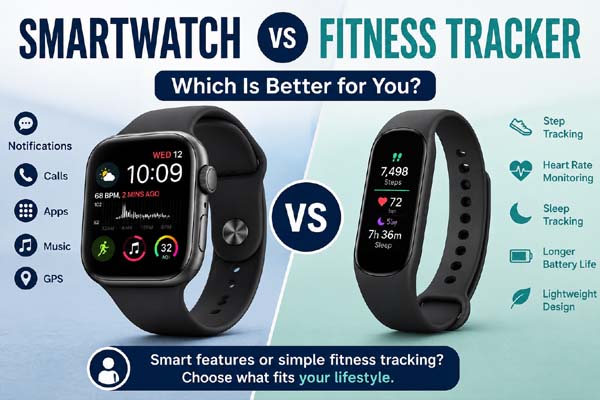
If you want more than basic activity tracking, a smartwatch is usually the better all-round choice because it combines fitness features with notifications, apps, calls, navigation, and other smart functions. A fitness tracker is better if your main goal is monitoring steps, sleep, heart rate, and workouts in a simpler, often more affordable device. The right option depends on how much you value smart features, battery life, fitness tracking, and everyday convenience.
What Is the Difference Between a Smartwatch and a Fitness Tracker?
The main difference is their purpose. A smartwatch is designed to act like a small extension of your smartphone while also tracking health and fitness. A fitness tracker focuses more heavily on activity and wellness measurements.
Fitness trackers are generally smaller and lighter. They can monitor steps, distance, calories, heart rate, sleep, and selected workouts. Many models also provide notifications, but their smart features are usually more limited.
Smartwatches tend to have larger displays and more advanced software. Depending on the model, you may get GPS, music controls, contactless payments, calls, messages, apps, workout tracking, and health features.
| Feature | Smartwatch | Fitness Tracker |
| Step tracking | Yes | Yes |
| Heart-rate monitoring | Usually | Usually |
| Sleep tracking | Yes | Yes |
| GPS | Common | Available on some models |
| Notifications | Advanced | Basic to moderate |
| Apps | Usually | Limited |
| Battery life | Usually shorter | Usually longer |
| Design | Larger | Smaller and lighter |
| Best for | Fitness + smart features | Simple health tracking |
Smartwatch vs Fitness Tracker for Fitness and Health
Both devices can be useful for building healthier daily habits, but their capabilities vary considerably by model.
A fitness tracker can be an excellent choice if you mainly want to count steps, monitor your activity, track sleep, and keep an eye on your heart rate. Its lightweight design can also make it comfortable to wear throughout the day and night.
A smartwatch may offer more advanced workout tools. Built-in GPS can be useful for runners, cyclists, and walkers who want to record outdoor routes without carrying their phone. Many smartwatches also support a wider selection of exercise modes and provide more detailed workout information.
However, neither type should automatically be treated as a medical device. Health measurements from consumer wearables can be useful for general wellness, but they should not replace professional medical advice or diagnosis.
Battery Life, Comfort, and Everyday Use
Battery life is one of the biggest differences to consider. Many fitness trackers can run for several days between charges, while feature-rich smartwatches often need charging more frequently.
That difference matters if you want continuous sleep or activity tracking. A device that needs frequent charging may spend more time sitting on your charger than on your wrist.
Comfort is another important factor. Fitness trackers are usually slimmer and lighter, making them appealing for people who dislike wearing larger watches. Smartwatches generally have bigger screens, which makes reading messages, checking workouts, and using apps easier.
Think about your routine. If you want something discreet that quietly tracks your activity, a fitness tracker may be enough. If you want a wrist-based device that replaces some phone functions, a smartwatch makes more sense.
Which One Should You Buy?
Choose a fitness tracker if you:
- Mainly care about steps, sleep, heart rate, and workouts.
- Prefer a lightweight device.
- Want longer battery life.
- Do not need many apps or smart features.
- Want a simpler wearable for everyday activity tracking.
Choose a smartwatch if you:
- Want fitness tracking and smartphone features in one device.
- Need GPS for outdoor activities.
- Want to read notifications or messages from your wrist.
- Like music controls, apps, payments, or calling features.
- Prefer a larger, more interactive display.
Price should also influence your decision. There are affordable options in both categories, but advanced smartwatches can become considerably more expensive as features increase.
Conclusion and FAQs
For the Smartwatch vs Fitness Tracker decision, there is no single winner for everyone. A fitness tracker is ideal for straightforward health and activity monitoring, while a smartwatch is better for people who want fitness features alongside everyday smart functions. Choose based on the features you will actually use rather than simply buying the device with the longest feature list.
See how 8GB vs 16GB vs 32GB RAM compares and choose the right option for your needs.
FAQs
Is a smartwatch better than a fitness tracker?
Not necessarily. A smartwatch is more versatile, while a fitness tracker can be better for simple activity monitoring, comfort, and longer battery life.
Can fitness trackers track sleep?
Yes. Many fitness trackers include sleep-tracking features, although the available measurements and accuracy can vary between devices.
Do smartwatches track workouts?
Yes. Most modern smartwatches offer workout tracking, and some include GPS and specialized activity modes.
Which has better battery life?
Fitness trackers generally offer longer battery life because they have fewer power-intensive smart features and smaller displays.
